
Le Vampire Strategy: Read the Mechanics First
RTP of 96.36% in this build, bets from €0.05 to €2,000, clusters of 5 symbols or more and a 15,000x ceiling: what to check before your first spin.
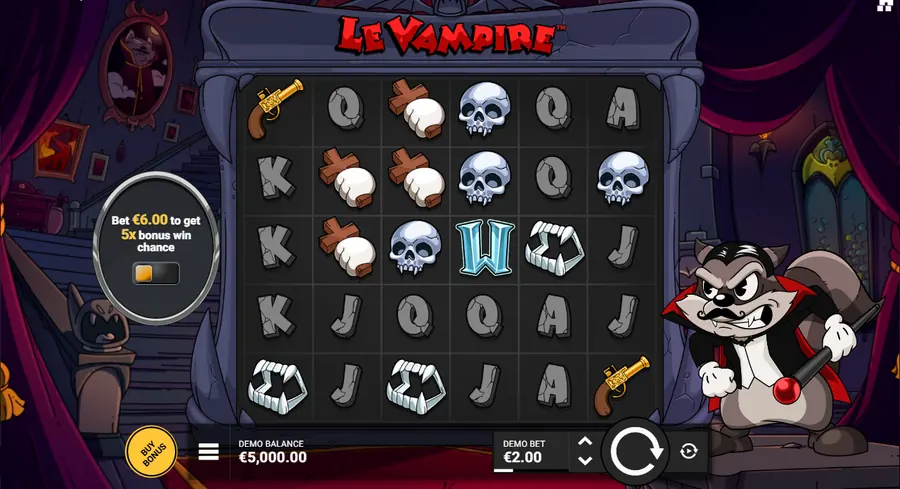
A strategy for Le Vampire comes down to three decisions made before the first spin: confirm the RTP of your own build, decide how far the budget stretches, and know what to watch once a bonus starts. No betting scheme moves the odds. This cluster slot from Hacksaw Gaming runs on 6 reels and 5 rows, pays on 5 or more connected matching symbols and carries a medium volatility rating (3/5), and every round comes out of a random number generator. What follows is the order in which the game is worth reading.
📑 Table of contents
What Strategy Can and Cannot Change
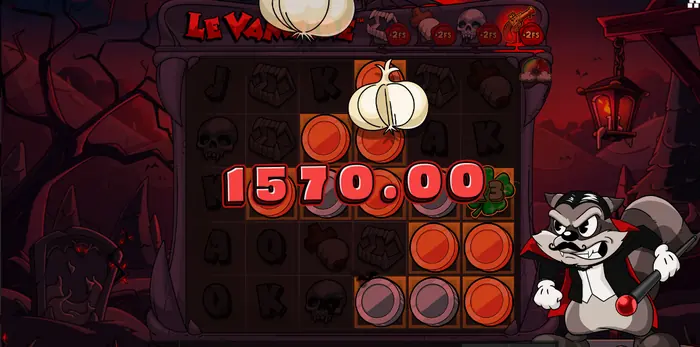
Strategy in Le Vampire changes how you behave, never the odds. A random number generator decides every round, and no bet combination, no progression and no amount of watching previous spins shifts the distribution of outcomes. You cannot calculate when a big win lands, time a bonus trigger or pick a luckier game: there is one game in the lobby, and the only variable is the moment you decide to stop.
Five things stay under your control, and each of them belongs before the first spin: the bet size, the number of rounds, the loss limit, the win limit in autoplay, and the point where the session ends. Set them and a random process becomes a managed budget. Everything else you do is observation rather than influence.
One exception is worth knowing up front. A bigger bet does not improve your bonus odds, but activating BonusHunt does: it is a separate paid feature costing 3x your bet, and it multiplies the chance of triggering a bonus game by five. No guarantee comes attached, so a large bet on its own buys nothing, while the paid feature genuinely shifts the odds.
Demo mode follows the same logic. If you would rather see the board, the cascades and the bonus modes before you risk anything, it is easier to check the mechanics in the free demo, where you can practise at any stake without financial risk.
A Practical Order Before You Pick a Bet
Start inside the game's own help panel (Shift + I or G). Its parameters section lists the bet range, the RTP of the build you are actually playing, the volatility rating and the bonus modes on offer. Then open the paytable (Shift + P) and check what each symbol type returns at each cluster size, because every figure in there multiplies whatever stake you settle on.
The three bonus modes deserve a look at this point as well, since they handle highlighted cells differently from one another, and each of them is bought as a multiple of your bet. The Bonus Buy menu prints that price before you commit to anything, so read it there rather than after the purchase.
Check which RTP configuration your build runs on, since the provider publishes several and only the help panel names the one that is live in your lobby. Figures taken from an article about Le Vampire may describe a different version of the game, though the symbol set, the cluster rules and the bonus mechanics stay the same across all of them.
Paytable and Symbol Value
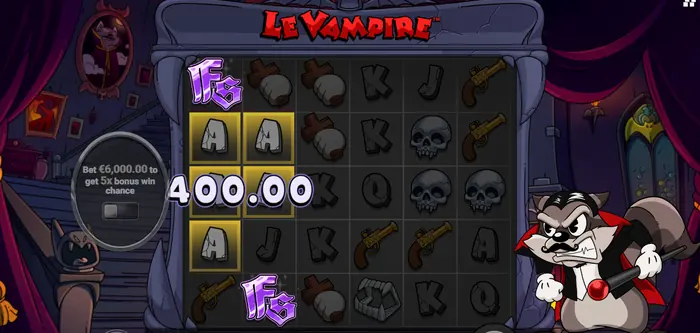
The paytable reads along two axes: the symbol type and the size of the cluster. The minimum pays on 5 symbols joined horizontally or vertically, so a near-cluster running diagonally pays nothing. The multipliers below belong to the base game.
| Symbols | 5 | 6-7 | 8-9 | 10-11 | 12-13 | 14+ |
|---|---|---|---|---|---|---|
| J, Q, K, A | 0.2x | 0.4x | 0.6x | 2x | 10x | 50x |
| Fangs, garlic | 0.4x | 0.6x | 1x | 3x | 15x | 75x |
| Skull, pistol | 0.6x | 1x | 2x | 5x | 20x | 100x |
| Epic fangs, Epic garlic | 0.8x | 1.2x | 2x | 6x | 30x | 150x |
| Epic skull, Epic pistol | 1.2x | 2x | 4x | 10x | 40x | 200x |
Read the top row first. J, Q, K and A pay identically, so the difference between them is purely visual. The Epic versions of the high-value symbols are where the money sits: on 14 or more matches an Epic skull or Epic pistol returns 200x against 100x for the standard pair. Epic symbols appear inside the bonus modes, and only once a symbol of that type has already taken part in a winning combination.
Worked example at a €1 bet: a cluster of 12 pistols pays 20x, which is €20, while the same run of 14 Epic pistols pays 200x, or €200. At €2 those figures double, because every value in the table is a multiplier of the current bet rather than a fixed sum. That is also why the cash total on screen depends on the bet you chose, even when the combination sitting on the board is identical.
Special Symbols and Activation Conditions
Several symbol types follow different logic here, and they are easy to mix up. Wild stands in for any symbol on the paytable, so it joins every cluster. Scatter FS only starts the bonuses: 3 FS opens Coffin Break, 4 FS opens Love at First Bite, 5 FS opens the hidden Do Your Fang. Rainbow and Epic Rainbow never share the board with FS, and only one of them can be present at all.
A separate class of cells and collect symbols does the heavier lifting. Golden Squares appear beneath winning symbols and accumulate until a Rainbow activates them. Blood Squares behave the same way, with one exception: they never reveal a Bronze Coin. The coins carry fixed denominations, Bronze Coin from 0.2x to 4x, Silver Coin from 5x to 10x, Gold Coin 20x, 30x, 40x or 50x, and Diamond Coin 100x, 150x, 250x or 500x of the bet. Those multipliers apply to the current bet at the very end of the calculation, once the coins, bags and pots have been added together.
Clover works as a multiplier. Green Clover multiplies the coins and any Bag of Gold or Pot of Gold on neighbouring cells, Gold Clover multiplies across the entire board. The available values are 2x, 3x, 4x, 5x, 10x or 20x. Bag of Gold collects values from a 3x3 area while Pot of Gold takes in the whole board, so a pot tends to land next to a larger total even when the individual coins are small.
None of this is worth building a schedule around. Rainbow, Clover and Epic Rainbow come out of a random calculation, and no bet size or round count makes them arrive on cue. What helps is deciding beforehand what you will do when they show up: read the final total, write it down, carry on with your plan.
Watching Cascades
Super Cascades in Le Vampire is not a separate round. It is a chain of calculations inside a single spin: the board is checked for winning clusters, the winning symbols are removed, the freed positions fill with new symbols, and the board is checked again. The cycle repeats until nothing new is winning. Every payout along the chain feeds into the round total, and when several clusters of different types land in one spin their payouts are added together, with only the largest applicable win paid for each winning path.
That summation is also why the figure on screen can run well past the largest single number in the paytable. A chain of four paying clusters collects four payouts, and the interface shows you the sum rather than the best one of them.
Knowing how to read the display matters for one more reason. The interface shows the result of the current round in Win, while a bonus mode shows Total Win next to the remaining spin count. Two numbers, two meanings: Win is what this spin paid, Total Win is what the whole bonus session has banked so far. A figure you can account for is a figure you can judge against the budget you set before you started.
Observation Frequency Versus Probability
Five big wins in a row in demo mode do not make a sixth one likely. Every round is independent: the generator produces a result without reference to what came before. What a short session shows you is a frequency of observations, and across thousands of spins the distribution spreads out towards the theoretical value of the game.
Demo mode is therefore worth your time for the rules and worth nothing for expectations. Play a demo session and you learn how the board behaves, how the cascades run and what a bonus looks like on screen, and you still cannot say anything about the spin that comes next.
You can test the principle where it matters most. The advanced autoplay settings take a session loss limit and a single win limit, and the automatic play stops on its own once either one is reached. Those limits live in the interface and do not depend on how you feel in the moment, which makes them steadier than any intention you form before sitting down.
Do Not Raise Your Bet After a Streak
Some habits look harmless and are not. "Add a bit, things are going well today" breaks the main budgeting rule, which is that the bet comes out of a sum set aside beforehand rather than out of your mood after the previous spin.
The practical version of that rule: your stake stays fixed for the session, or it moves according to a step you wrote down in advance, for example a change tied to how much of the budget is left. If you raise the bet after a run, the only way to keep the session limit unchanged is to shorten the session, which means fewer rounds overall.
A smaller bet does the opposite. It stretches the same money across more spins and slows the drain, and the extra rounds are genuinely useful for learning a mechanic you have not met before. Turbo Play is built for the opposite problem, raising the pace of the spins, and some operators and jurisdictions do not offer it at all.
Bonus Modes: What to Track
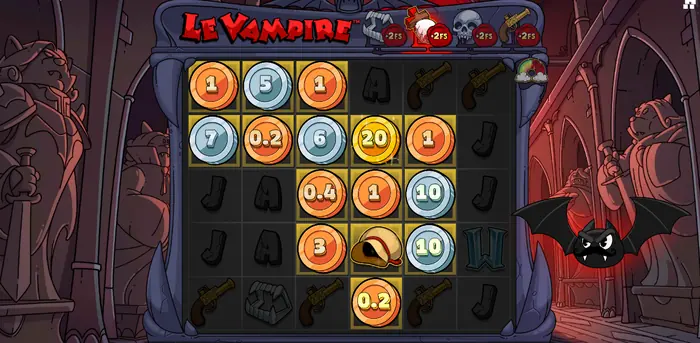
Le Vampire has three free spins bonuses and each is built differently. Coffin Break starts on three Scatter FS, Love at First Bite on four, the hidden Do Your Fang on five. Every mode gives you 10 free spins, keeps the cluster wins and Super Cascades of the base game, and adds the conversion of high-value symbols into Epic Symbols along with a progressive Symbol Bar.
Four things are worth tracking while a bonus runs:
- the spins remaining and the amount sitting in Total Win beside them;
- the highlighted Golden Squares and Blood Squares that pile up and wait for a Rainbow;
- the Symbol Bar level and how many spins it will still add;
- any Epic Symbols on the board, since their presence lifts paytable values up to 200x on 14 or more matches.
Scatter FS does not drop inside the bonuses, so no new bonus can start while one is running. Everything that happens inside a mode fits within the spins you were granted plus the extra levels of the bar.
Coffin Break and the Upgrade Progress
The engine of Coffin Break is the Symbol Bar, a scale that sits outside the game board. Each symbol type converted into an Epic Symbol pushes the bar up one level, every level adds 2 free spins, and the fourth level adds 2 more plus a guaranteed Rainbow or Epic Rainbow on the next spin. Four levels together come to 8 extra spins.
The order of events matters more than it looks. A high-value symbol (fangs, garlic, skull or pistol) takes part in a winning combination, the win is paid first, and only then do all symbols of that type turn into Epic Symbols. The conversion also applies to symbols that arrive later, so a single good cluster can push the bar forward and lift the payouts that follow it. Wins are processed left to right, which means that when one round contains several combinations with the same high-value symbol, the conversion happens after the first of them has been handled.
When an Epic Symbol itself lands in a winning combination, the cell beneath it turns into a Blood Square. Here the highlighted Golden Squares and Blood Squares live only until a Rainbow activates them, and they are spent at that moment. Love at First Bite keeps the highlighting alive after the activation, which is the one real behavioural difference between the two modes.
Extra Spins and the Price of Purchases
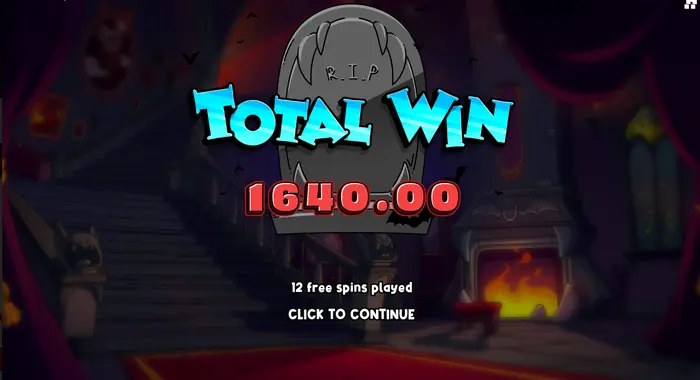
Extra spins arrive through the bar at 2 per level, up to 8 across four levels. Treat them as part of a random bonus scenario rather than as a signal to act: a longer series changes the total, and it gives you no reason to enlarge the budget or raise the bet while the mood is good.
How much to set aside for a bonus gets decided before the purchase, and the Bonus Buy menu prices every mode as a multiple of your bet:
| Mode | Price | RTP | What it changes |
|---|---|---|---|
| Coffin Break | 60x | 96.25% | Direct purchase of the bonus round |
| Love at First Bite | 250x | 96.26% | Direct purchase, highlighted cells survive a Rainbow |
| BonusHunt | 3x | 96.31% | Raises the chance of a bonus trigger, no guarantee attached |
| Rainbow Bite | 75x | 96.12% | Guarantees a Rainbow or Epic Rainbow on every spin |
| Rainbow Epic Drop | 500x | 96.36% | Guarantees an Epic Rainbow on every spin |
Each mode carries its own return, so the RTP of your main build cannot simply be carried over to a purchase. If the session is going according to plan, continue it that way; if the budget is gone, the extra spins stay unused.
Bankroll and Session Limits
Before the first spin, write down three numbers: the amount you are willing to lose in full, a time limit, and a stopping point. The money should be spare, not taken from everyday expenses. The time limit matters because it gets you away while your decisions are still good ones. The stopping point is a rule that fires on its own: the loss limit reached, the win target passed, or the allotted time simply gone.
Progressive systems fail here for a simple reason: each one assumes a losing run has to end, and the budget pays for that assumption long before the assumption pays off. Martingale, doubling after a loss and Fibonacci all raise the stake exactly when the balance is already lower than it was, so the recovery plan quietly turns into the reason the session ends early. Chasing what you lost with fixed stakes is the most common way to leave with more gone than you planned to lose.
The full rule set, the bonus modes and the symbols are collected on the page with the basic rules and features of Le Vampire, which is also where to look up any sign in the paytable that leaves you unsure.
Bet Size and Session Length
Fit the bet to the budget, never the other way round. The rules give a standard range of €0.05 to €2,000, and every figure in the paytable is a multiplier of the current bet: at €0.05 the smallest cluster of 5 cards returns €0.01, and at €2,000 that same cluster returns €400. Divide the budget by the number of rounds you actually want to play, and the arithmetic hands you a stake the session can survive past the first few spins.
A smaller stake buys you more rounds, which is exactly what you want while learning a mechanic and exactly what you cannot use to chase a bonus. Bonus purchases and FeatureSpins are charged as multipliers of the bet, so a single purchase at the top of the range asks for a sum that most gambling bankrolls simply do not carry.
If you cannot stop calmly once the agreed number of rounds is up, lower the bet or shorten the session. The game should end by decision rather than by the pull of one more spin.
When to Take a Break
Stop if even one of these shows up:
- the urge to win it back, and the thought that the next round will close the gap usually means the limit has already gone;
- your bets rising under emotional pressure rather than following a rule you wrote down in advance;
- the money you set aside is gone, or the time you allotted has run out;
- the game crowding out sleep, work or time with the people close to you;
- you are playing with borrowed money, or taking cash out of a reserved budget.
Technical help exists for the tired moments. The advanced autoplay settings take a loss limit and a win limit, and the Stop button halts automatic play on the spot, which hands control to the interface at the moment you are least able to judge it yourself. The rules and conditions for playing for real money, along with the list of available operators, sit in the section on bets and real money play.
RTP, Volatility and the Win Ceiling
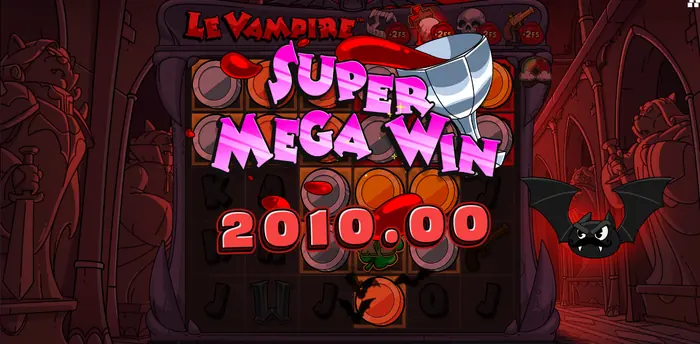
Three numbers in this game get misread more often than any others, so they deserve their own weights. The 96.36% RTP of your build is a theoretical return over a very long distance, modelled by the provider over 10,000,000,000 rounds. It is not a promise to hand you 96.36%, and it says nothing about an individual session. Volatility of 3/5 (medium) tells you how widely payouts are spread and how often the large ones turn up, and nothing about the next ten spins. The 15,000x limit is a ceiling: the round ends the moment it is reached and the remaining bonus spins are cancelled, so it is not something to count on.
| Metric | Value | What it means |
|---|---|---|
| RTP of the main build | 96.36% | Theoretical return over billions of rounds, not a forecast for a player |
| Provider configurations | 97%, 96%, 94%, 92%, 86% | Five versions of the game; check which one is active in your build |
| Volatility | 3/5 (Medium) | Spread of payouts and how often big wins appear |
| Maximum win | 15,000x bet | The payout ceiling; the round ends when it is hit |
| Bet range | €0.05 to €2,000 | Standard bets; bonus purchases are charged as multipliers |
| Game board | 6 reels x 5 rows | Clusters of 5 connected matching symbols |
Read that table as a description of the long run. A return of 96.36% across 10,000,000,000 rounds describes an average that no single session will resemble. What separates one session from the next is the spread around it, and that spread is where the volatility rating comes from. The budget has to be built for the spread, not for the average.
A Responsible Approach and Useful Pages
Strategy in Le Vampire means understanding the mechanics and keeping hold of the budget. The game is meant for adults, and everything described here works only while you keep a sober view of the process: you choose the bet and the length of the session, not the result.
If the game is new to you, the sensible order is to watch the mechanics in the demo first, then read the full rules with the paytable, and only afterwards decide whether this format suits you and whether you can live with the budget and the time limit it asks for. If at any point it feels like the game is sliding out of your control, a pause and professional support are the sensible next steps.
Not winning here is not a calculation error. It is the ordinary result of a bet with a negative mathematical expectation, and no plan changes that equation. What a plan does is let you pay for entertainment exactly what you decided in advance, and leave on time.
FAQ
What exactly does the bet size change, and what stays the same?
The bet sets what one multiplier in the paytable is worth, how fast the balance drains, and how many rounds your budget buys. Cluster odds, symbol frequencies and the chance of triggering a bonus do not move with it. The exception is BonusHunt, a paid feature at 3x the bet that multiplies the bonus trigger chance by five and guarantees nothing. A larger bet pays more for the same result.
Can a run of big wins tell me that it is time to bet more?
No. Rounds are independent, so a winning run carries no information about the next spin, and in demo mode what you observe is a frequency of observations rather than the probability of a future result. What you can do is decide in advance where the stake sits, and let the built-in autoplay loss and win limits end the session for you.
How does Love at First Bite differ from Coffin Break?
The trigger differs, 3 FS for Coffin Break and 4 FS for Love at First Bite, while both give 10 free spins, the Epic Symbol conversion and a Symbol Bar worth 2 extra spins per level. The difference that shows up in play is what happens to the highlighted cells when a Rainbow activates them. Coffin Break spends them at that moment, Love at First Bite keeps them lit, so the same cells can be filled and activated again later in the session.
Why is a bonus purchase so expensive at the maximum bet?
Because a purchase is charged as a multiple of the bet, and those multiples are large. A direct Coffin Break purchase at 60x the bet costs €60 at a €1 stake and €120,000 at €2,000, while Love at First Bite at 250x comes to €250 and €500,000. That fee buys the mode, not a result: the bonus can still end on zero, and the return on the purchase is the mode's own RTP rather than the figure printed for the base build.